By Sadaf Ahsan
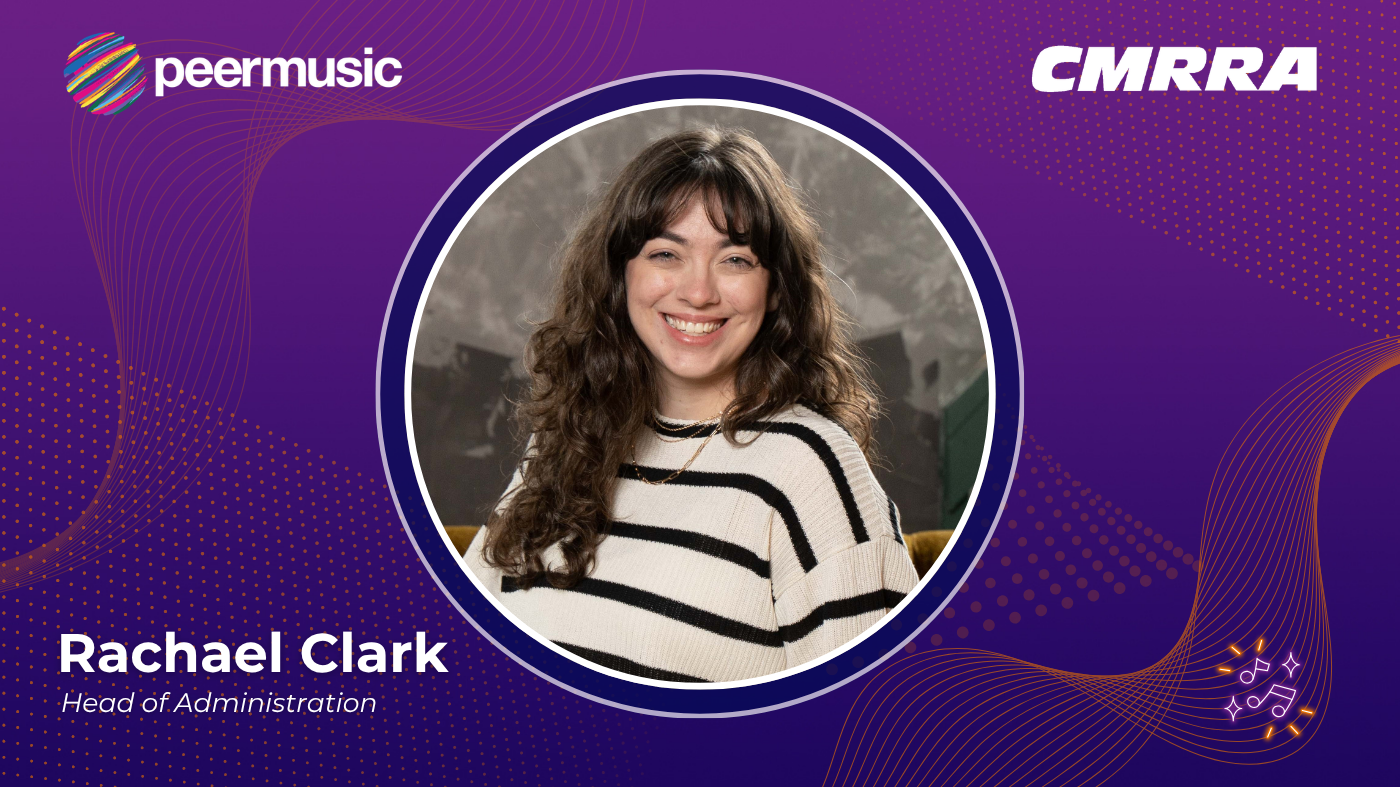
Rachael Clark didn’t set out to work in spreadsheets. But somewhere between playing CDs on the daily as a teen, spinning tracks as a student radio DJ and booking local shows in Hamilton, she discovered that the music industry isn’t just built on sound — it runs on systems.
Now, as Head of Administration at publisher peermusic Canada, Clark works at the intersection of creativity and operations, helping ensure songwriters are paid accurately and on time. It’s meticulous work, often invisible, and increasingly important in an industry shaped by streaming, data and constant change.
“I knew that I wanted to work in music from a young age, but it didn’t really matter how,” Clark says. “My dad is a trumpet player on the side, in addition to doing insurance. So, I was always around music, and listening to [everything] from jazz all the way to heavy metal. Once I found music publishing, I knew that this was exactly what I wanted to do. I take a lot of pride in [it].”
Her path into the industry wasn’t linear so much as cumulative. She began in radio broadcasting at McMaster University before moving into live music promotion and booking. After enrolling in Durham College’s music business administration program, she initially envisioned a future in venue management. Until, that is, she realized the lifestyle wasn’t for her (a night owl she may be, Clark is no longer a student, and has less interest in being out “too late”).
Instead, she pivoted toward the administrative side of the industry. A role at Canadian Musical Reproduction Rights Agency (CMRRA) proved formative. Though she didn’t land the job she initially applied for, she was offered another position days later, an early lesson in adaptability. There, she worked in catalogue tracking, which proved invaluable.
“Having the real-world experience is 10 times more valuable than just learning it from a book or an instructor.” Clark says.
That experience also led her directly to peermusic. While managing accounts at CMRRA, Clark worked closely with the publisher’s catalogue. When a predecessor recommended her for an open role, she applied, and stood out in part for an unexpected reason.
“There was a royalty math question in the interview process and, apparently, I was the only person to get it right,” she recalls, with a laugh.
Nearly a decade on, Clark remains at peermusic, where she oversees a wide range of responsibilities, including royalty processing, data management and broader operational oversight. Like at many Canadian music companies, she says, the role requires “wearing multiple hats.” But what drew her in is the scale and legacy of the catalogue.
Peermusic’s holdings span decades, and include a vast range, like folk standards from the Carter family, and work from contemporary Canadian icons, like The Tragically Hip, Corey Hart, Brendan Canning of Broken Social Scene, The Stampeders, TALK, and Peter Peter, who composed the score for the hit series Heated Rivalry. As Clark says, “Being involved in that sort of historical context and having an influence on new songwriters and their journeys was really important to me.”
Still, Clark’s work is as much about the future as it is the past. Streaming has dramatically increased the volume of data publishers manage, something she says has reshaped the job in just the last few years.
Each stream generates only fractions in royalties but, across millions of plays, those fractions matter. For Clark, the challenge is making sure that information is processed accurately and transparently.
“People want to see speed and accuracy, and we need to have systems in place to make sure that that is happening,” she says. Collective Management Organizations like CMRRA play an important role in supporting the end-to-end administration process, helping ensure high-volume data processing remains efficient, accurate, and timely.
That systems-focused approach shapes her view of emerging technologies, including AI. While cautious about its role in creative production, Clark sees clear potential on the administrative side, particularly as a tool for data processing, ingestion, reconciliations and the back-end processing of all that information. Looking ahead, she’s most interested in improving the fundamentals, like data standardization and transparency between organizations.
“We’re all in the business of exchanging data,” she says. “My hope is that there’s a way to make that flow a lot better, but that’s all years down the line. Right now, everyone has a say.”
As a musician herself, Clark also brings a practical understanding of what songwriters need, including tour preparation, rehearsal and financial stability.
“Understanding the mechanics of that firsthand gives people who work behind the scenes a more robust understanding of what artists go through on a day-to-day basis,” she adds. “So when we’re issuing an advance to a client, for example, and they’re about to go on tour, we can really understand what that advance would mean to them in their preparation process.”
That empathy informs the core of Clark’s work. While publishing can often feel abstract, built around contracts, systems, and data, she sees it as deeply personal.
“It’s about making sure that they’re paid what they’re owed,” she says. “The goal is protecting the songwriter, and making sure that their work is being exploited in the right ways.”
It’s a philosophy that aligns with a broader shift in the industry, as conversations around rights, royalties and fairness take centre stage. But Clark is quick to point out that the fundamentals haven’t changed; knowledge and education remain key.
“It’s really important to educate emerging songwriters…to know what their rights are, know what a publisher is and know what avenues there are to collect royalties in Canada and the rest of the world,” she says.
For emerging professionals, her advice is similarly grounded. Technical skills matter — Excel proficiency, in particular — but so do interpersonal ones. She explains, “Being a people person is important, because you’re not just dealing with your own clients; you’re dealing with the greater industry. You’re dealing with internal personnel, so having good networking and communication skills is always a good idea.”
Clark also encourages young people entering the industry to look beyond its more visible roles.
“When I went into my program, everybody wanted to do A&R or artist management.” she says. “But the publishing side often gets overlooked. It’s a very, very important component to a songwriter’s career.”
For Clark exactly what makes the work meaningful: helping songwriters understand their rights, navigate the business and get properly paid for their work.